
GoExch9 Login: Easy and Secure Account Access
To access your GoExch9 login, open a trusted login page, enter the GoExch9 ID created during registration, type your password, and complete any security check shown. This beginner-friendly page walks you through each step and helps solve common sign-in problems.
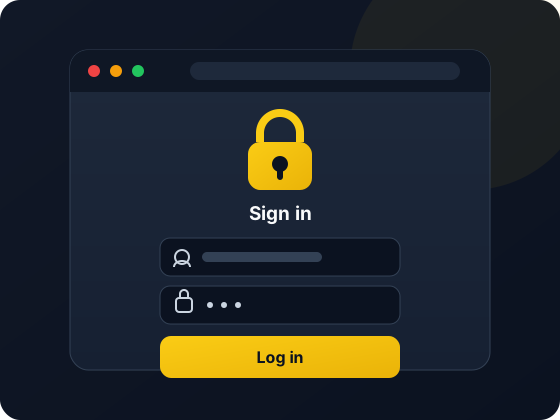
How to access GoExch9 login
Signing in is simple once your details are ready.
Updated 6 July 2026 — the official GoExch9 login help. GoExch9 is the official home of the GoExch9 platform, and we walk you through account access step by step so you can sign in with confidence.
Accessing your GoExch9 login means signing in to an account that was created during registration. In short: open a trusted login page, enter your GoExch9 ID, type your password, and confirm any security step. If everything matches, you are taken to your account screen within a few seconds. That is the whole idea in one sentence, and for most people it really is that quick once the details are ready.
The reason we wrote a full page rather than a single line is that a lot of small things sit around those few seconds. Which link you open, how you store your password, whether your browser is up to date, which device you are on, and how you leave the session afterwards all shape how safe and smooth your sign-in feels. Beginners in particular tell us that the login itself was easy, but knowing what a normal screen looks like, what a warning sign looks like, and what to do when something does not match is where they wanted more help. That is exactly what this page sets out to cover.
This is the official GoExch9 login help, written in a beginner-friendly way. It explains the search terms people commonly use, such as goexch9 login, goexchange9 login and go exchange 9 login, so you can follow clear steps whichever spelling brought you here. All of those phrases point at the same simple task: reaching an account that already exists. If you have not created an account yet, begin with GoExch9 Register and set up your GoExch9 ID first, because you cannot sign in without those details. Trying to log in before an ID exists is one of the most common reasons a first attempt appears to fail.
Good login habits matter as much as the steps themselves. Using a saved, trusted link, a strong password, and an updated browser makes every sign-in faster and safer. Think of it like locking your front door: the routine only takes a moment, but it is the routine that keeps things secure. The sections below cover a quick preparation checklist with the reason each item matters, a full step-by-step walkthrough, a description of what a successful login looks like, a deep troubleshooting section, password and session safety, mobile tips, and how to stay clear of fake login links. You can read straight through or jump to the part you need.
Login checklist before you start
A few quick checks prevent most sign-in delays — and here is why each one matters.
Every item below removes one common cause of a failed or slow sign-in. Running through the list takes under a minute, and once it becomes a habit you will rarely think about it again. We have added a short reason after each point so you understand what could go wrong if it is skipped, rather than just following a list on trust.
- Your GoExch9 ID (username) created during registration. This is the name the account recognises. Without the exact ID there is nothing for the login to match against, and a guessed or half-remembered ID is the number-one reason a first attempt bounces back.
- Your current password, typed carefully and kept private. The password proves the account is yours. Keeping it private is what stops anyone else from reaching your session, and typing it slowly avoids the tiny slips that make a correct password look wrong.
- A trusted, bookmarked login link rather than a random search result. A saved link is one you have already checked, so it protects you from look-alike pages that copy the design to capture details. Random results and forwarded links are where most fake-page trouble begins.
- A stable internet connection on your phone, tablet or computer. A weak or dropping signal is the hidden cause behind many "page will not load" and "it froze halfway" reports. A steady connection lets each step finish cleanly instead of timing out.
- An updated browser with cookies enabled for a smooth session. Cookies let the site remember you have passed each step; with them blocked, a login can loop back and ask you to verify again. An updated browser also handles security checks and captchas correctly.
- A private, personal device instead of a shared or public one. Your own device is far less likely to have saved another person's details or hidden software watching input. Shared and public machines are the riskiest place to type a password, so avoid them where you can.
- Access to your recovery method in case you need a password reset. If you ever forget the password, the recovery option is what gets you back in. Confirming you can reach your recovery email or contact before you need it turns a stressful lockout into a two-minute fix.
Quick tip: Keep your ID and recovery details written somewhere private and offline, not in an unlocked notes app on a shared phone. You want them handy to you and only you.
Step-by-step login walkthrough
Follow these five simple steps for a smooth GoExch9 account access experience.
Open the correct login page
Start from a trusted, bookmarked GoExch9 login link or a page shared by your support contact, and confirm the web address before typing any details.
Enter your GoExch9 ID
Type the GoExch9 ID (username) that was set up during registration. Check for accidental spaces or a wrong keyboard layout.
Enter your password carefully
Type your password exactly as created. Passwords are case-sensitive, so watch the Caps Lock key and any auto-correct suggestions.
Complete any verification step
If a security check, code or captcha appears, complete it. This extra step helps protect your account access.
Sign in and review your session
Select the sign-in button, wait for the page to load, and confirm you are on the expected screen. Always sign out on shared devices when finished.
Tip: If you use the same device often, bookmark the correct login page. This helps you avoid look-alike links and speeds up every future sign-in.
What a successful login looks like
Knowing the "after" picture helps you spot when something is off. A normal, successful sign-in follows a predictable pattern. When you select the sign-in button, the page should think for a moment and then move you forward on its own, without asking for the same details a second time. You land on your own account screen, the web address stays on the page you started from, and nothing on screen is asking you to re-enter your password to "confirm" or to claim an unexpected reward.
A few signals tell you the session is healthy: the page loads fully rather than freezing halfway, any welcome or account information shown looks like yours, and the browser padlock or address bar has not changed to a different, unfamiliar site. If you passed a verification step, you should not be pushed back to it straight away. If instead you are bounced back to the login box, asked to verify repeatedly, or redirected somewhere you did not expect, treat that as a cue to stop and check the troubleshooting and safety sections below before trying again.
Finally, remember the closing habit. A successful login is not truly finished until you have decided how to leave it. On your own device you can stay signed in; on any device you share, plan to use the proper sign-out option when you are done. We cover safe signing out in detail further down the page.
Common login problems and simple fixes
Most sign-in trouble has a quick, practical solution. Here are the six issues we see most, with what usually causes each one.
Wrong ID or password
This is the most frequent hiccup, and it is almost always a small typing slip rather than a real account problem. Re-type your details slowly, check that Caps Lock is off, and remove any extra spaces at the start or end. Turn off autofill if it keeps inserting an old password. Reveal the password with the eye icon, if there is one, so you can see exactly what you typed before submitting.
Page will not load
A blank, frozen or endlessly spinning page usually points at the connection rather than your details. Refresh once, check that other sites open, and switch between Wi-Fi and mobile data to test the link. If it still stalls, try a different browser or device. A weak signal, an overloaded public network, or a background download eating your bandwidth are the usual culprits behind timeouts.
Forgot password
There is no need to panic or create a brand-new account. Use the reset or recovery option on the login screen, verify your identity through the method offered, and then create a new strong password you have not used anywhere else. Our password reset walkthrough covers the whole process step by step, including what to do when a code never arrives. If you cannot see a reset option at all, that is a moment to contact support rather than keep guessing.
Verification failing
If a code or captcha will not accept, refresh it and read it carefully, because a lower-case l and the number 1 are easy to confuse. For time-based codes, the single most common fix is correcting your device clock, since a phone set to the wrong time will generate codes that no longer match. Complete each step without refreshing halfway, and request a fresh code if the first one has expired.
Old cached data
Sometimes the browser holds on to an outdated version of the page, which can block a fresh session or show an old error. Clear your browser cache and stored cookies for the site, then close and reopen the browser and reload the page. Opening a clean private-browsing window is a fast way to test whether stale cached files were the problem, without wiping everything at once.
Still stuck
If you have worked through the fixes above and still cannot get in, stop repeating the same attempt and reach out. Note down what you tried and the exact wording of any message you saw, then contact our support page for step-by-step account access guidance from a real person. Clear details get you a faster, more accurate answer than "it will not work".
Troubleshooting decision list
If you prefer a straight "this, then that" path, follow the branch that matches your symptom. Work down each one in order and stop as soon as you are back in.
- If the page will not load → refresh once, confirm another website opens, switch between Wi-Fi and mobile data, then try a different browser or device before assuming the account is at fault.
- If it says wrong password → re-type slowly, turn Caps Lock off, reveal the characters, disable autofill, and only then use the reset option — do not keep hammering the same entry, which can trigger a temporary lock.
- If it says the ID is not recognised → check for typos and spaces, confirm you actually finished registration, and if you never created an ID, start with GoExch9 Register before anything else.
- If verification keeps failing → correct your device date and time, request a fresh code, read look-alike characters carefully, and complete the step without refreshing midway.
- If the login loops back and asks you to sign in again → enable cookies, leave private-browsing mode, clear the site's old cached data, and pause any security tool that blocks session storage.
- If the address or page looks unfamiliar → do not enter your password, close the tab, and open the site from your own saved bookmark instead, then read the fake-link safety section below.
- If none of the above works → gather the details of what you tried and head to support for guided help rather than guessing further.
Password safety deep-dive
Strong password habits protect your GoExch9 account access more than anything else you do.
Your password is the single lock on your account, so it deserves a little thought. The good news is that a strong password is not about being clever; it is about being long and unique. A longer password is dramatically harder to guess than a short one, even a short one packed with symbols. A memorable phrase of several unrelated words, with a number and a symbol mixed in, is both easy for you to recall and hard for anyone else to work out. What you want to avoid is anything tied to you personally, because that is the first thing a stranger would try.
The reason we stress a different password for each account is simple: if one service is ever compromised, people test those leaked details everywhere else. Reusing your email password here, or this password on your email, links the two together so that one weak point unlocks both. Keeping them separate contains any single problem to one place. This is where a trusted password manager earns its keep — it remembers long, unique passwords for you so you only ever have to recall one strong master phrase.
Do this
- Create a long password — a phrase of several words is stronger than a short jumble.
- Mix in letters, numbers and a symbol so it is not a plain dictionary word.
- Use a different password here than on your email or any other account.
- Store it in a trusted password manager, or write it somewhere private and offline.
- Update it periodically, and always after signing in on a shared or borrowed device.
- Change it immediately if you ever suspect someone else has seen or typed it.
Avoid this
- Names, birthdays, phone numbers or simple sequences like 123456 or qwerty.
- The same password you already use for email, social media or shopping.
- Sharing your password over chat, a call, email or a screen-share with anyone.
- Saving it in an unlocked notes app on a phone other people can pick up.
- Typing it into a page you reached from an unexpected message or pop-up.
Note: No genuine support process will ever ask for your full password. Treat any such request — by message, call or email — as a warning sign, and keep your login details entirely private. Real help never needs your password to assist you.
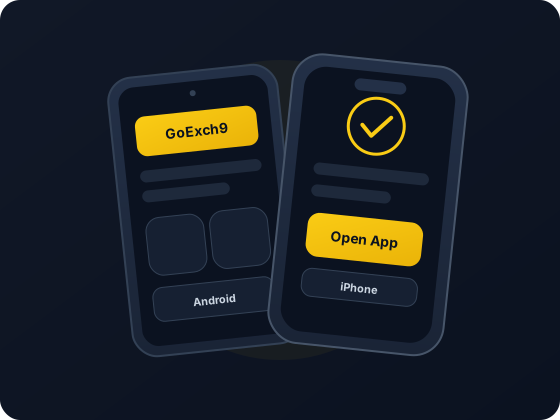
Mobile login tips
Signing in on a phone or tablet is quick when your device is ready.
Most people now sign in from a phone, and the experience is mobile-friendly, so the steps are the same as on a computer. The differences are small but worth knowing. A phone keyboard makes it easier to fat-finger a character, so use the show-password option to check what you typed. A screen lock and up-to-date software give a mobile session real protection, while a smaller address bar makes it slightly harder to inspect a link — so bookmarking the correct page matters even more on mobile.
- Keep your browser and device software updated for a smoother, safer session.
- Use a reliable Wi-Fi or mobile connection to avoid timeouts and dropped steps.
- Prefer your personal device rather than a shared or public one.
- Turn off aggressive autofill if it inserts outdated details.
- Set a screen lock so a lost phone does not become an open door.
- Sign out fully when you finish, especially on a borrowed phone.
For a dedicated walkthrough of mobile access on Android and iPhone, see the GoExch9 App page, and read the GoExch9 mobile article for more device tips.
Session security and signing out on shared devices
How you leave a session matters as much as how you start it.
A "session" is simply the period during which your device stays recognised after you sign in. On your own phone or computer, a session that stays open is a convenience — you can come back later without typing everything again. On a device that other people can reach, that same open session is a risk, because whoever uses the machine next may still be signed in as you. The habit that protects you is deciding, every time, whether this is a device you trust to stay logged in.
The most important point is that closing a tab or the browser window is not the same as signing out. A closed window can leave the session quietly active in the background. To end it properly, use the actual sign-out or log-out option. That step tells the site you are finished and clears the recognised session, which is exactly what you want before you hand a shared computer back or return a borrowed phone.
On a shared or public device, do this every time
- Decline any "remember me" or "save password" prompt before you sign in.
- Use the proper sign-out option when you finish — do not just close the tab.
- Clear the browsing history and any saved passwords for the site afterwards.
- Prefer a private-browsing window, which forgets the session once it is closed.
- Glance back at the screen before you walk away to confirm you are fully signed out.
On your own trusted device you can relax most of this, though a screen lock and an occasional password refresh are still sensible. If you ever realise you left a session open somewhere you should not have, the safest response is to change your password, which ends older sessions and forces a fresh sign-in.
Staying safe from fake login and phishing links
The login page is exactly where fake look-alike links try to catch people, so this is worth a careful read.
Because a login page is where you naturally expect to type an ID and password, it is the favourite target for fake pages. These are copies designed to look like the real thing so that anything you enter is captured. The single best defence is boringly effective: reach the login page from your own saved bookmark or a link from a verified support contact, and never from an unexpected message. If you always start from your own bookmark, a fake link has almost no way to reach you.
It helps to know the shape of these tricks so you can recognise one quickly. Fake links usually arrive out of the blue, create a sense of urgency, and dangle something that sounds too good — a bonus, a prize, or a warning that your account will close unless you act now. The web address is often slightly off: an extra word, a swapped letter, an odd ending, or a jumble that does not match the site you know. A genuine sign-in never needs you to "reconfirm" your password through a link in a message.
Warning signs of a fake login link
- It arrived unexpectedly by message, email or social media and pushes you to hurry.
- The web address is misspelled, has extra words, or ends in an unfamiliar way.
- It promises a reward, bonus or refund in exchange for signing in right now.
- It asks for your full password, a one-time code, or payment details up front.
- The page looks almost right but small details — spacing, logos, wording — feel off.
Safer habits that keep you clear of them
- Always open the login page from your own bookmark, never from a forwarded link.
- Check the full web address before typing anything, and stop if it does not match.
- Ignore urgency and rewards — pressure is the tactic, not a real feature of signing in.
- Keep one-time codes to yourself; a code you share is a code someone else can use.
- If a link feels wrong, verify it through our support page before acting.
If you think you entered details on a fake page: change your password straight away from your trusted bookmark, sign out of any open sessions, and contact support to explain what happened. Acting quickly limits the impact.
When to contact support
Some situations are easier to solve with guided help.
Most login issues are fixed with the steps above, but a few cases are genuinely worth reaching out about rather than retrying on your own. Contact support if you cannot reset your password or cannot find a reset option at all, if verification keeps failing after several careful attempts, if you notice sign-in activity you do not recognise, if you think you may have entered details on a fake page, or if a page behaves in an unexpected way that the troubleshooting section did not solve. Getting help early keeps your account access smooth and secure, and there is no such thing as a silly question here.
To get the fastest answer, describe what you tried and the exact wording of any message that appeared, plus the device and browser you were using. Clear details let the team pinpoint the cause instead of asking you to repeat steps. You can also review the GoExch9 ID page if your issue is really about setting up or locating your account identity rather than the sign-in itself, or GoExch9 Register if you never finished creating an account. For login-specific background, the GoExchange9 login and access article walks through the same journey in article form.
Reminder: GoExch9 is for users aged 18+ only. Please follow the laws that apply in your region and practise responsible use of our platform.
Frequently Asked Questions
How do I access GoExch9 login?
Why is my GoExch9 login not working?
Can I use GoExch9 login on mobile?
What should I do if I forget my password?
Is GoExchange9 login the same as GoExch9 login?
How can I tell a real login link from a fake one?
Why does the login page keep asking me to verify again?
How do I sign out safely on a shared or public device?
Should I save my password in the browser?
Do I need a new ID every time I log in?
Is mobile login as safe as logging in on a computer?
Explore GoExch9
Keep going with the sibling pages that pair naturally with signing in.
GoExch9 Register page
New here? Create an account and set up the details you will sign in with.
Open the register pageGoExch9 ID page
Understand the account identity you enter every time you log in.
Open the ID pageGoExch9 App page
Device-specific mobile access tips for Android and iPhone users.
Open the app pageSupport
Stuck after trying the fixes? Get friendly, step-by-step account access help.
Visit supportLogin and access article
The full GoExchange9 login journey explained in article form.
Read the articleGoExch9 mobile tips
More tips for a smooth, secure sign-in on phones and tablets.
Read the mobile articleReady to sign in with confidence?
Follow the steps above, keep your details private, and reach out any time you need clear, friendly account access guidance.