
GoExch9 Responsible Gaming: How to Set Limits That Work
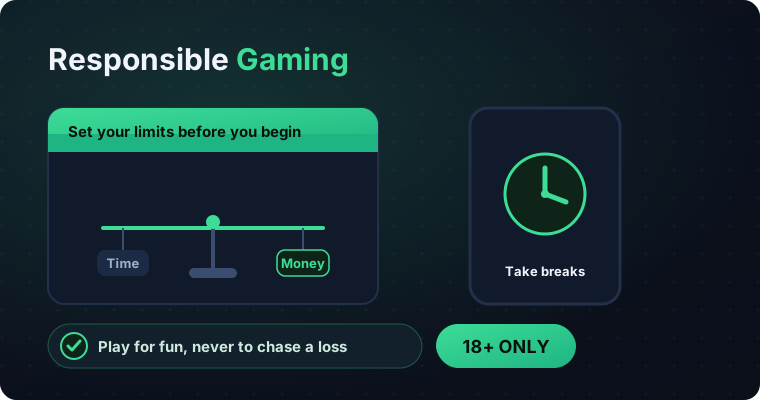
Enjoying yourself and staying in control are not opposites — in fact, the people who have the most relaxed time are usually the ones who set their limits first and stick to them. This is official GoExch9 content, written for adults aged 18 and over, and its whole purpose is to help you keep any play firmly in the "entertainment" column. It makes no promises about amounts or outcomes, because no outcome on any gaming platform is ever guaranteed. What it does offer is a calm, practical framework: how to decide your limits before you begin, how to recognise when the fun is slipping, and where to turn if you or someone close to you needs a hand.
Official GoExch9 page, updated 30 July 2026. Responsible gaming is for adults aged 18 and over, only where permitted by local law. Treat any spend as the cost of entertainment, set limits before you start, and step away whenever it stops feeling fun.
The Right Mindset: Entertainment, Not Income
Everything about responsible gaming flows from one simple idea: this is a form of entertainment, not a way to earn. Once you hold that thought firmly, the rest becomes much easier. You would not expect a cinema ticket or a night out to pay for itself, and the same framing keeps play healthy here. Some sessions will go your way and some will not, and both are simply part of the experience you paid for. Deciding, before you begin, that any spend is the cost of a bit of fun takes the pressure off completely — there is nothing to "win back" and nothing to prove.
This mindset also protects your everyday life. When play sits in the entertainment budget alongside other leisure, it never competes with the money you need for essentials. If you are still getting oriented, the complete guide for new users covers the basics of how the platform works, and the responsible-use page keeps these principles in one place for easy reference.
Setting a Money Limit That Holds
A money limit only works if you set it before the session starts and treat it as fixed. Deciding on a figure in the heat of the moment rarely holds, because the moment is exactly when it is hardest to be objective. Here is a calm way to arrive at a limit you can actually keep.
- Budget it like any leisure cost. Pick an amount you would happily spend on an evening out and be comfortable not seeing again.
- Keep it separate from essentials. Never draw on money set aside for rent, bills, food or savings, and never borrow to play.
- Decide the figure in advance. Set it while you are calm, before you open your account for the session, not once you are already playing.
- Stop when you reach it. Whether you are ahead or behind, hitting your limit is the signal to close the session for the day.
One more habit is worth building: check in with the limit honestly rather than quietly nudging it upward. A limit you keep moving is not really a limit. If you ever feel the figure creeping, that is itself a useful sign to pause and revisit the sections below.
Setting a Time Limit and Taking Breaks
Money is only half the picture. Time slips away easily when you are absorbed in something, so it helps to decide in advance how long a session will last and to build in natural breaks. A simple approach works best.
Decide the session length first
Before you start, pick a comfortable window — the length of a match, an episode, a set amount of time — and treat the end of it as the end of the session.
Set a gentle reminder
A simple timer or phone alarm pulls you out of the moment and lets you check in with how you are feeling, rather than losing track entirely.
Take real breaks
Step away from the screen, move around and do something unrelated. A short break makes it far easier to decide clearly whether to stop or continue.
Log out when you are done
Ending the session cleanly — actually logging out rather than leaving it open — makes the boundary real and removes the temptation to drift back in.
If you ever want to step away for longer, that is not a failure — it is a healthy choice. Setting the activity aside for a day, a week or more is always available to you, and the support resources further down can help if you would like firmer backup.
Warning Signs Worth Noticing
Most of the time, play stays comfortable and fun. But it helps to know the early signals that it might be drifting somewhere less healthy, because catching them early makes them easy to act on. Keep a quiet eye out for these.
- Spending more than you planned — on either time or money — on a regular basis.
- Continuing to win back a loss rather than stopping at your limit.
- Borrowing money or using funds meant for essentials to keep playing.
- Hiding the activity from a partner, family or friends.
- Feeling anxious, low or irritable when you are not playing, or thinking about it a lot at other times.
None of these mean anything has gone irreversibly wrong — they are simply signposts. If one or two feel familiar, treat it as a gentle nudge to pause, revisit your limits, and take a break. If several ring true, the responsible-use page and the support links below are a good next step.
Why Chasing Losses Backfires
Of all the habits worth avoiding, chasing losses is the most important. "Chasing" means carrying on in the hope of winning back money you have already spent, and it is risky for a straightforward reason: it quietly turns a fixed limit into an open-ended one. The decision to keep going is driven by how a loss feels rather than by any plan, and feelings in that moment tend to push in exactly the wrong direction.
The calmer response is the one you decided on in advance. A loss is simply the cost of the entertainment you already enjoyed, the same way a spent cinema ticket is. When you reach your limit, closing the session is not "giving up" — it is the plan working as intended. There is always another day, and coming back fresh, within a new limit, keeps the whole thing light and enjoyable. If you find it genuinely hard to stop after a loss, that difficulty is itself worth taking seriously, and the support below exists for exactly that.
Where to Find Support
Reaching out is a sign of strength, not weakness, and doing it early — while any concern is still small — is always easier than waiting. There is no cost and no judgement in asking a question, whether it is about your own play or someone you care about.
- Start with the responsible-use page. It gathers practical limits and links to independent organisations that offer free, confidential help.
- Talk to someone you trust. Simply saying it out loud to a friend or family member often makes the next step clearer.
- Take a firm break. Stepping away for a set period gives you space to reset, and you can return — or not — entirely on your own terms.
- Contact support for account questions. If your question is about your own account rather than your play, reach support from the official goexch9.org site.
Whatever prompted you to read this, the fact that you are thinking about limits at all is a good sign. Responsible gaming is not about stopping the fun — it is about keeping it fun.
Quick Recap
Responsible gaming comes down to a few calm habits. Treat any play as entertainment rather than income, and set both a money limit and a time limit before you begin. Keep that money completely separate from essentials, never borrow to play, and stop when you reach either limit — whether you are up or down. Take real breaks, log out cleanly, and watch for the early signs of chasing or spending more than you planned. Above all, avoid chasing losses, and reach out early through the responsible-use page if the fun starts to fade. GoExch9 is for adults aged 18 and over, and no outcome is ever guaranteed — staying in control is what keeps it enjoyable.
Explore GoExch9
Is GoExch9 Safe?
A calm checklist to confirm the official site and spot look-alike pages before you share any details.
GoExch9 Customer Support
How to get help the right way, what to include, and how to spot fake "support".
GoExch9 for New Users
A plain-English orientation to how account access works and where to find help.
GoExch9 Account Verification
What KYC is, the documents a check may involve, and how to complete it safely.
Responsible Use
Practical limits and links to independent support organisations, all in one place.
Support
Friendly help for any account question the guides do not already answer.